Tamil Nadu’s AI, Space and Industrial Push: New Opportunities for Jobs, Businesses and the Next Generation
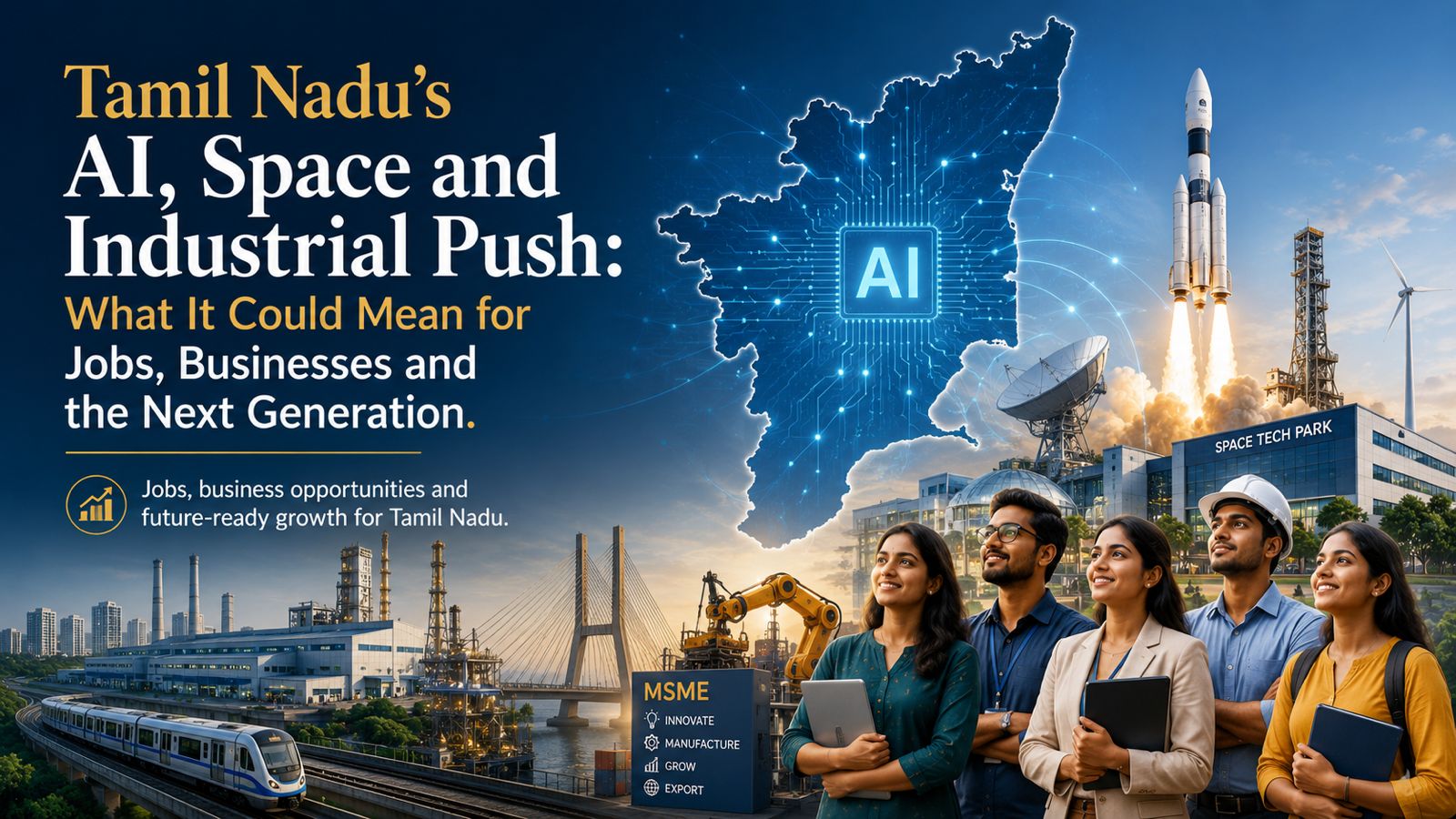
Tamil Nadu’s AI, Space and Industrial Push: What It Could Mean for Jobs, Businesses and the Next Generation
Tamil Nadu is preparing for a new phase of industrial growth—one increasingly shaped by Artificial Intelligence, deep technology, advanced manufacturing, space technology, entrepreneurship and digital infrastructure.
The Tamil Nadu Revised Budget 2026–27 contains several announcements that deserve attention not just from large companies and investors, but also from students, working professionals, entrepreneurs, MSMEs and educational institutions.
The important question is not simply how much money is being invested.
The bigger question is:
What new opportunities could these investments create for the people of Tamil Nadu?
₹35,062 Crore in MoUs and Potential Employment Opportunities
According to the Revised Budget, the Tamil Nadu Government has signed seven Memoranda of Understanding worth approximately ₹35,062 crore, with the potential to generate 14,790 direct and indirect employment opportunities.
The state is also working toward expanding industrial infrastructure, attracting new investments and creating an ecosystem capable of supporting emerging industries.
For job seekers, this is significant because industrial investments do not create opportunities only inside large companies.
They can also create demand across:
Supply chains
Logistics
Technology
Financial services
Marketing
Consulting
Human Resources
Data and Business Analytics
Operations
Supporting businesses and service providers
Key takeaway: Large investments can create opportunities far beyond the companies making the investments. Entire business ecosystems can grow around them.
Arivagam: Tamil Nadu's Proposed AI and Deep-Tech City
One of the most interesting announcements is Arivagam, proposed as a dedicated Artificial Intelligence and innovation city.
The planned ecosystem is expected to include:
An AI university
An international skill-development centre
A semiconductor hardware testing laboratory
Multi-domain innovation incubators
Advanced computing infrastructure
AI and deep-tech companies
Research institutions
Quantum technology ventures
Enterprise capability centres
A feasibility study has been proposed with an estimated cost of ₹5 crore.
This is important because an AI ecosystem is much larger than software development alone.
It can potentially create opportunities for:
Engineers | Analysts | Researchers | Product Professionals | Finance Professionals | Marketers | HR Teams | Consultants | Entrepreneurs | Business Managers
The future AI economy will need people who understand both technology and business problems.
This is where the next generation of opportunities could emerge—not only in coding or AI development, but also in business operations, analytics, finance, consulting, product management, marketing and entrepreneurship.
Southern Tamil Nadu Could Become a Space-Technology Hub
Another major announcement is the proposed Space Industrial Investment Zone covering Thoothukudi and Tirunelveli.
The zone will be centred around the strategic Kulasekarapattinam spaceport.
The Government has also proposed establishing a Space Vehicle Common Technical Facility in collaboration with IN-SPACe to support private enterprises, startups and research organisations operating within the ecosystem.
This could be particularly important for southern Tamil Nadu.
Historically, many high-technology employment opportunities have been concentrated around major metropolitan centres.
Building specialised industrial ecosystems in other districts can potentially create opportunities closer to where people live, while encouraging entrepreneurship and strengthening local supply chains.
Space Technology Means More Than Rocket Engineering
A growing space ecosystem can require expertise in:
Electronics
Advanced manufacturing
Data analytics
Software development
Cybersecurity
Communications
Logistics
Project management
Finance
Specialised component manufacturing
A space-tech ecosystem can create opportunities for engineers, businesses, startups, suppliers and professionals across multiple industries.
₹3,200 Crore Proposed for New Industrial Parks
The budget also proposes that SIPCOT establish new industrial parks in industrially backward districts.
Approximately ₹3,200 crore over five years has been estimated for these developments, with industrial parks planned around the sectoral strengths of individual districts.
This is an important approach.
Tamil Nadu's future growth cannot depend only on Chennai, Coimbatore or a handful of established industrial regions.
When investment reaches more districts, it can create opportunities for:
Local employment
Small businesses
Vendors and suppliers
Logistics providers
Service companies
Skilled technicians
Entrepreneurs
Women-led enterprises
Local graduates
Balanced industrial development can create a multiplier effect across local economies.
A new industrial park does not create opportunities only inside factories. It can also create demand for transportation, accommodation, food services, maintenance, finance, technology, recruitment, training, marketing and many other supporting services.
Tamil Nadu's MSMEs Could Play a Major Role
Tamil Nadu has approximately 43.47 lakh registered Micro, Small and Medium Enterprises, according to the state budget.
The Revised Budget provides ₹2,142 crore for the MSME Department, while also allocating funding to initiatives including the:
Tamil Nadu Women Entrepreneurs Empowerment Scheme
Capital subsidies
Green-steel development
Business and manufacturing support initiatives
This matters because large industrial investments rarely operate alone.
They depend on networks of smaller companies.
For example:
An automobile plant may require hundreds of component suppliers.
A semiconductor ecosystem requires specialised vendors and technology providers.
A space ecosystem needs manufacturers, software companies, logistics providers, testing services and engineering businesses.
An AI ecosystem creates opportunities for technology startups, consulting companies and specialised solution providers.
For Tamil Nadu entrepreneurs, therefore, the opportunity is not simply to ask:
“Which large company is coming to Tamil Nadu?”
A better question may be:
“What problems will these new industries need smaller companies to solve?”
That is where many future entrepreneurial opportunities could emerge.
Investment Approval Is Also Becoming More Digital
Tamil Nadu has also proposed Guidance 3.0, an AI-powered investment service system.
The upgraded Tamil Nadu Single Window Portal 3.0 is intended to bring statutory approvals, clearances and no-objection certificates required by industries into a unified interface.
The state also plans to create a Tamil Nadu Industrial Capability Directory, which would digitally showcase manufacturing and supply-chain capabilities to investors.
If implemented effectively, such initiatives could:
Improve the visibility of Tamil Nadu's industrial ecosystem
Help investors identify suppliers and partners
Simplify business approvals
Improve access to industrial information
Increase opportunities for local manufacturers and MSMEs
Digital infrastructure is becoming just as important as physical industrial infrastructure.
What Does All This Mean for Students?
Perhaps the most important implication is for students and young professionals.
Industries are evolving much faster than traditional academic curricula.
A graduate entering the workforce over the next five years could encounter jobs that require combinations of skills that were uncommon even a few years ago.
For example:
Engineering + AI
Finance + Data Analytics
Marketing + Automation
Manufacturing + AI
HR + Analytics
Commerce + Digital Technology
Operations + Data
Business Management + AI
This means students should begin thinking beyond certificates.
Employers increasingly need people capable of applying knowledge to actual business problems.
Students should focus on developing three forms of career capital:
1. Knowledge
Understand the fundamentals of the chosen field.
Knowing the concepts remains important because practical skills become much stronger when they are supported by a solid foundation.
2. Practical Skills
Learn the tools, technologies and working methods actually being used in industry.
The ability to apply knowledge is becoming increasingly important in technology-driven workplaces.
3. Proof
Build:
Projects
Portfolios
Internships
Case studies
Practical assignments
Industry exposure
Demonstrable outputs
A certificate says you completed something. Proof shows what you can actually do.
Colleges Also Have an Important Role
The industrial transformation of Tamil Nadu creates an equally important challenge for educational institutions.
Colleges cannot predict every individual job that will exist five years from now.
But they can prepare students to adapt, learn and apply new technologies.
This requires stronger collaboration between:
Industry → Colleges → Skill-Development Organisations → Students
Curriculum knowledge must increasingly be supported by:
Industry projects
Practical tools
Internships
Industry visits and exposure
Skill assessments
Communication development
Problem-solving
Career preparation
Interview readiness
The objective should not only be to help students graduate. It should also be to help them become capable of participating in the industries being created around them.
The AJ Academy Perspective
At AJ Academy, we see one message becoming increasingly clear:
Employability cannot be separated from economic transformation.
When a state attracts AI companies, semiconductor businesses, manufacturers, space-technology companies and startups, the education ecosystem must simultaneously prepare people capable of working inside those industries.
The future of education should therefore move from:
Learn → Write Exam → Get Certificate
toward:
Understand → Practice → Build → Demonstrate → Get Opportunity
Tamil Nadu's industrial ambitions represent an exciting opportunity.
But infrastructure alone cannot create transformation.
Infrastructure needs investment.
Investment needs businesses.
Businesses need skilled people.
And skilled people need the right education and practical exposure.
The states that successfully connect these four elements will be best positioned for the next decade of economic growth.
Tamil Nadu is beginning to build the industries of tomorrow.
Now we must ensure that Tamil Nadu's students, professionals and entrepreneurs are ready to build their futures alongside them.
— AJ Academy
Source: Tamil Nadu Revised Budget Estimates 2026–27 and publicly reported state industrial-development announcements.