Tamil Nadu Budget 2026–27 Explained: Key Highlights, Major Schemes, Allocations & What It Means
Tamil Nadu Budget 2026–27 Explained: Key Highlights, Major Schemes, Allocations & What It Means
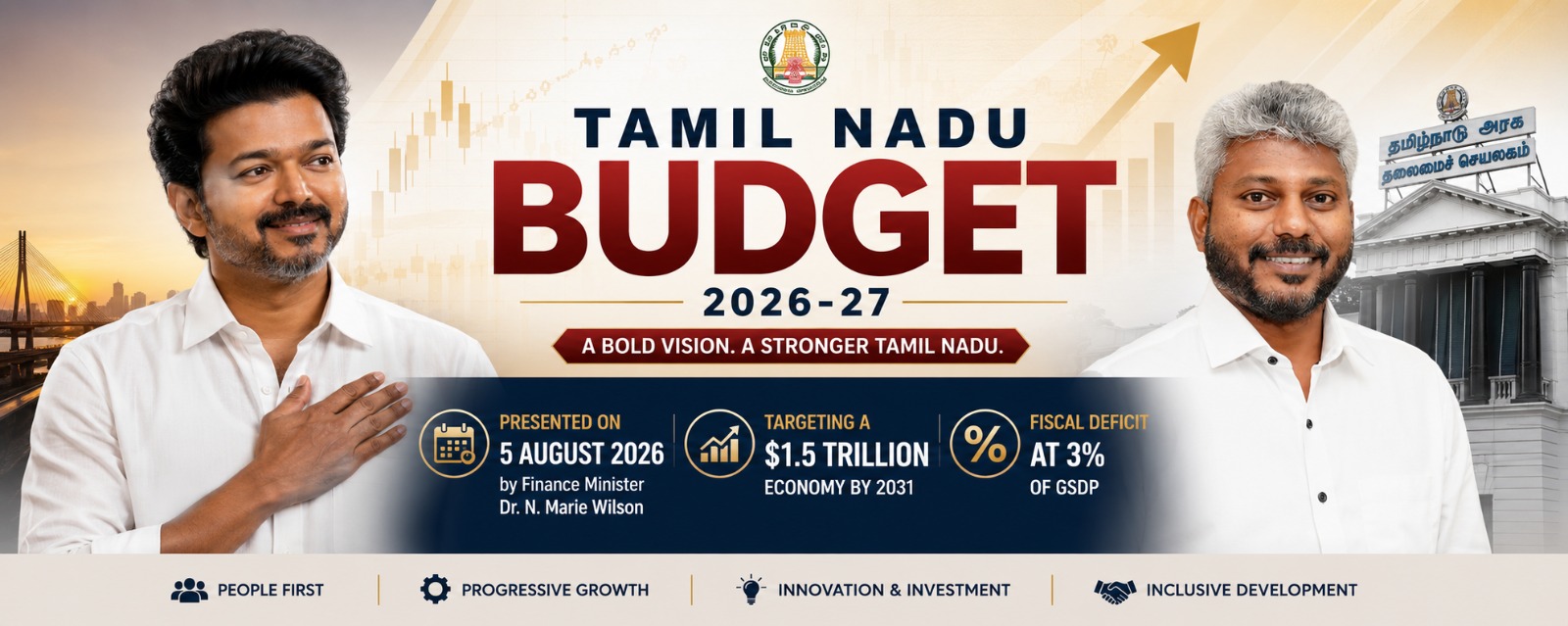
The Tamil Nadu Budget 2026–27, presented on 5 August 2026 by Finance Minister Dr. N. Marie Wilson, marks the first full budget of the TVK-led government.
The government has outlined an ambitious goal of building Tamil Nadu into a $1.5 trillion economy by 2031, while attempting to maintain fiscal discipline and keep the fiscal deficit around 3% of Gross State Domestic Product (GSDP).
From education and employment to infrastructure, agriculture, welfare, clean energy and Artificial Intelligence, the budget introduces several major initiatives.
Here are the key highlights.
Tamil Nadu Budget 2026–27: The Big Numbers
The government has proposed a total expenditure of ₹4.73 lakh crore for 2026–27.
The fiscal deficit is estimated at approximately ₹1.22 lakh crore, equivalent to around 3% of GSDP.
Capital expenditure has been allocated at ₹56,985 crore, indicating continued investment in infrastructure and long-term development projects.
Tamil Nadu's total outstanding debt is expected to reach approximately ₹10.99 lakh crore by March 2027, representing around 27% of GSDP.
Which Departments Received the Highest Allocation?
Education continues to remain one of the biggest priorities in the state budget.
Major departmental allocations include:
School Education – ₹44,527 crore
Rural Development – ₹39,609 crore
Municipal Administration & Water Supply – ₹29,863 crore
Health – ₹23,357 crore
Highways & Ports – ₹21,524 crore
Among these departments, School Education receives the largest allocation.
The numbers indicate a strong focus on education, rural development, public infrastructure, healthcare and urban development.
Major New Schemes Announced
Several new welfare and development schemes have been introduced in the 2026–27 budget.
Annan Seer Thittam
Under the Annan Seer Thittam, eligible brides will receive an 8-gram gold coin along with a saree.
The government has allocated approximately ₹812 crore for the programme.
Thai Maaman Thanga Mothiram
The Thai Maaman Thanga Mothiram scheme proposes to provide a 1-gram gold ring to newborn babies delivered in government hospitals.
Approximately ₹560 crore has been allocated for the initiative.
Vetri Laptop Scheme
The government has allocated ₹2,000 crore under the Vetri Laptop Scheme to provide laptops to college students.
The initiative is expected to improve digital accessibility and support technology-based learning among students.
Vetri Veedu
The Vetri Veedu housing programme aims to construct approximately 70,000 houses for families currently living in kutcha huts.
The scheme has been allocated ₹3,500 crore.
Super Clean, Super Campus
The government plans to improve infrastructure and sanitation across 10,000 government schools.
The programme will focus on:
Daily cleaning
Safe drinking water
Better toilets
Improved campus maintenance
Security
Approximately ₹139 crore has been allocated for the programme.
Arivagam – AI & Innovation City
One of the most futuristic announcements in the budget is Arivagam, proposed as India's first dedicated Artificial Intelligence and Innovation City.
An initial ₹5 crore has been allocated to conduct the feasibility study.
The project could potentially create a dedicated ecosystem for AI companies, startups, research organisations, universities and technology talent.
Climate Budget
Tamil Nadu has also announced a dedicated Climate Budget, with spending of up to ₹3,000 crore for climate-related initiatives.
The state becomes one of the early adopters of climate-focused budgeting in India.
Education and Youth Development
Education, skills and employment feature prominently in the budget.
New Student Hostels
The government proposes the development of approximately 200 new hostels providing nearly one lakh beds through TNSHIC.
The initiative includes a ₹10 crore corpus and a ₹640 crore grant.
The objective is to improve affordable accommodation for students pursuing higher education.
Vetri Skill Scheme
Approximately 13 lakh young people are expected to receive skill training through the Vetri Skill Scheme.
The programme aims to improve employability by preparing young people for evolving industry requirements.
Sports Development
Government schools are expected to introduce a daily sports period.
The government also proposes establishing 10 Olympic Centres, with approximately ₹50 crore allocated for the initiative.
This could help identify and develop young sporting talent across Tamil Nadu.
New Educational Institutions
The budget also proposes:
A new Government Law College in Madurai
A Tamil Nadu Institute of Design
Approximately ₹60 crore has been allocated for the Institute of Design initiative.
Healthcare and Social Welfare
Several programmes have been introduced to strengthen healthcare and welfare support.
Thai Care Centres
The government proposes establishing Thai Care Centres to provide maternity-related support.
Approximately ₹23 crore has been allocated.
Mobile Geriatric Units
Tamil Nadu plans to deploy 1,000 Mobile Geriatric Units across the state to provide healthcare support to elderly citizens.
Approximately ₹33 crore has been allocated for the programme.
Aran Shelter Homes
Aran Shelter Homes are proposed in five districts to provide accommodation and support services for transgender persons.
Nambikkai Illam
The government has announced Nambikkai Illam, institutions designed to support children with intellectual disabilities.
Approximately ₹4 crore has been allocated for the initiative.
Agriculture and Rural Development
Agriculture continues to receive significant financial support.
Farm Loan Waiver
The government has allocated approximately ₹5,932 crore towards farm loan waivers benefiting around 14.43 lakh farmers.
Increased Free Electricity
The free electricity allocation is proposed to increase from 100 units to 200 units.
The additional financial cost to the government is estimated at approximately ₹1,545 crore.
MGNREGA
Approximately ₹12,642 crore has been allocated towards the implementation of the Mahatma Gandhi National Rural Employment Guarantee programme.
Mangrove Restoration
Tamil Nadu plans to restore approximately 2,500 hectares of mangrove ecosystems.
The initiative has been allocated approximately ₹322 crore.
Mangrove restoration can play an important role in coastal protection, biodiversity conservation and climate resilience.
Infrastructure and Transportation
Infrastructure investment remains another major focus.
Chennai Metro Expansion
The government has proposed additional Chennai Metro connectivity, including routes such as Airport–Kilambakkam and other extensions.
Improved metro connectivity could significantly reduce road congestion while connecting emerging residential and commercial areas.
1,000 AC Electric Buses
The government proposes introducing 1,000 air-conditioned electric buses for Chennai's Metropolitan Transport Corporation.
Approximately ₹500 crore has been allocated towards supporting depot infrastructure.
The initiative combines public transportation improvement with Tamil Nadu's transition towards cleaner mobility.
Energy and EV Infrastructure
Tamil Nadu is also increasing its focus on electricity infrastructure and clean energy.
765 KV Transmission Line
A major 765 KV transmission line from Coimbatore to Ariyalur has been proposed.
The project is valued at approximately ₹4,000 crore and is expected to be implemented under a Public-Private Partnership model.
Rooftop Solar Subsidy
Households could receive subsidies of up to ₹1 lakh for rooftop solar installations.
The initiative aims to encourage decentralised renewable energy generation and reduce household electricity costs.
EV Charging Network
Tamil Nadu plans to establish approximately 20,000 public EV charging stations over the next five years.
The government has allocated approximately:
₹50 crore for public charging infrastructure
₹5 crore towards residential charging incentives
This could accelerate the adoption of electric vehicles across the state.
How Does the Government Plan to Increase Revenue?
The government expects its own tax revenue to increase by approximately 9.78%.
Commercial taxes account for around 68.9% of the state's own tax revenue, making them a major source of government income.
Another revenue measure is the proposed liquor privilege fee, which is expected to potentially generate up to ₹1,000 crore annually.
Fiscal Deficit Reduction Plan
The government has announced a gradual deficit reduction strategy.
The fiscal deficit is expected to move from approximately:
3.00% → 2.87% → 2.80%
over the period from 2026 to 2029.
The objective is to continue funding development programmes while gradually improving the state's fiscal position.
Political Reactions to the Budget
As expected, the budget has also triggered political debate.
DMK leader M.K. Stalin criticised the budget as a “damp squib.”
AIADMK leader Edappadi K. Palaniswami (EPS) also strongly criticised the proposals and reportedly gave the budget “zero marks.”
A major criticism from the opposition relates to several election promises that were not included in the budget, including proposals such as:
₹2,500 monthly financial assistance for women
Free LPG cylinders
The TVK-led government, however, has argued that it inherited significant financial liabilities and therefore needs to follow a two-year financial recovery strategy before implementing additional large-scale commitments.
What Does the Tamil Nadu Budget 2026–27 Really Focus On?
The budget appears to revolve around five major priorities:
Education and Skills
Large allocations for schools, laptops, student accommodation and youth skill development indicate a significant investment in human capital.
Social Welfare
Gold assistance schemes, housing initiatives, maternity care and support programmes form a substantial part of the welfare strategy.
Infrastructure
Metro expansion, electric buses, electricity transmission projects and housing remain important areas of capital investment.
Technology and Innovation
The proposed Arivagam AI & Innovation City indicates that Artificial Intelligence and emerging technology could become an important component of Tamil Nadu's future economic strategy.
Climate and Clean Energy
The climate budget, rooftop solar subsidies, mangrove restoration and EV infrastructure highlight the state's growing focus on sustainability.
Final Thoughts
The Tamil Nadu Budget 2026–27 combines welfare spending with investments in education, infrastructure, technology and clean energy while attempting to maintain fiscal discipline.
Among the most notable announcements are the Vetri Laptop Scheme, Vetri Veedu housing programme, gold assistance schemes, electric bus expansion, rooftop solar incentives, EV charging infrastructure, Climate Budget and the proposed Arivagam AI & Innovation City.
The larger challenge will be execution.
If these initiatives are implemented effectively, they could contribute significantly to Tamil Nadu's long-term economic and social development.
At the same time, the government's ability to manage rising debt, maintain its fiscal deficit targets and address remaining election promises will continue to be closely watched.
Ultimately, the success of the Tamil Nadu Budget 2026–27 will depend not only on how much money has been allocated, but on how effectively those allocations translate into employment, infrastructure, opportunities and measurable improvements in people's lives.