2026 to 2030: The Skills That Will Never Die
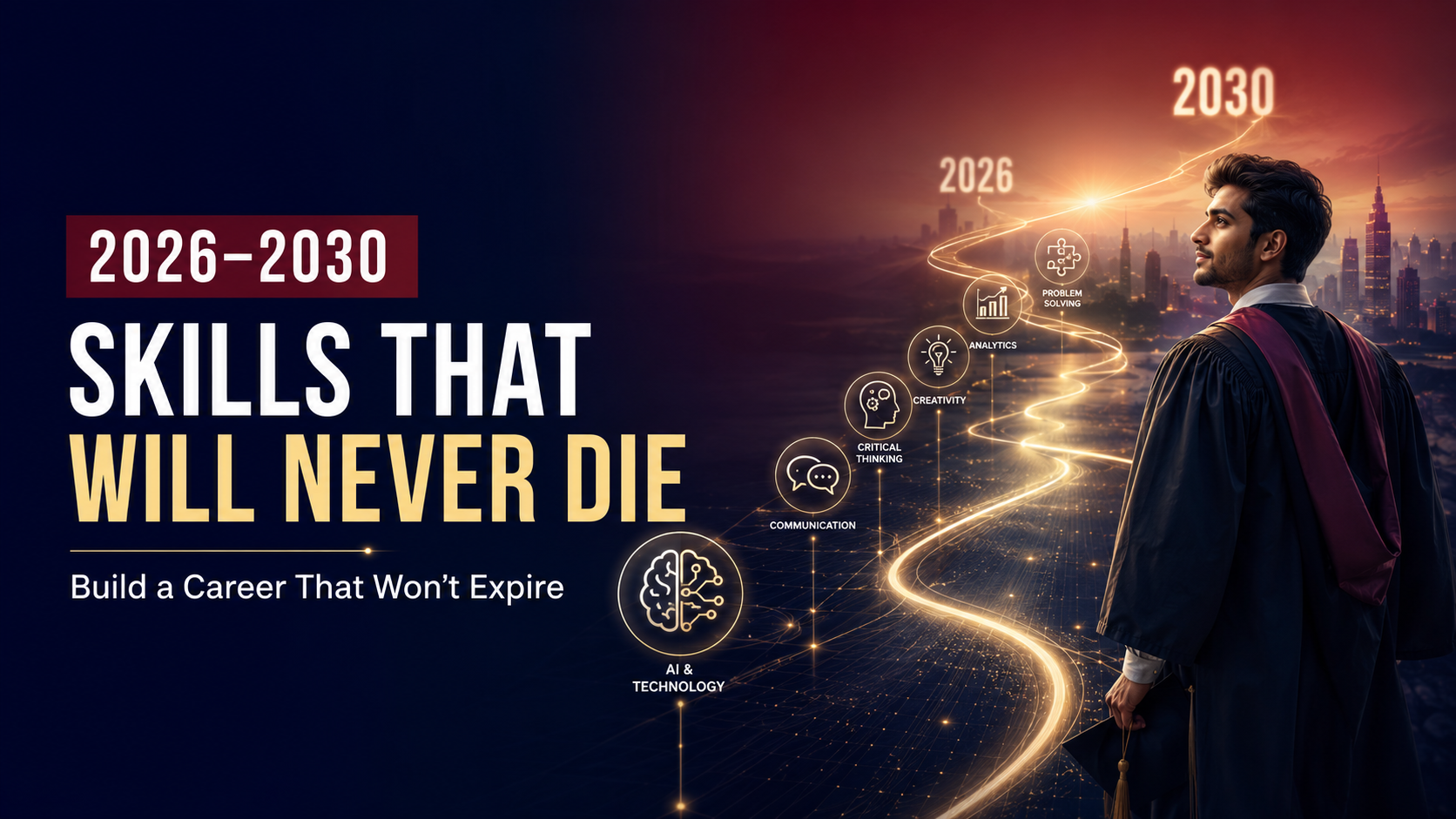
The future will not replace everyone—but it will reward those who are ready
In 2026, a young graduate named Arjun walked into his first job interview carrying a degree, several certificates and a carefully designed résumé.
The interviewer looked through his documents and asked:
What can you do that technology cannot do alone?
Arjun remained silent.He knew how to complete assignments. He knew how to score marks. But he had never learned how to solve an unfamiliar problem, communicate an idea confidently or use technology to create a meaningful result.Four years later, in 2030, Arjun attended another interview.This time, he did not begin by talking about his degree. He explained how he had used AI to analyse customer data, identify a business problem and develop a solution that increased sales. He presented his ideas clearly, answered difficult questions confidently and showed how he continued learning whenever technology changed.The interviewer did not ask how many certificates he had.
The interviewer asked:When can you join?
What changed between 2026 and 2030?
It was not Arjun’s degree. It was his skills.
The world is changing faster than our classrooms.Between 2026 and 2030, artificial intelligence, automation and digital platforms will continue transforming how businesses operate.Many repetitive activities will become automated. Reports that once required several hours may be created in minutes. AI will help people write, analyse data, design campaigns, create presentations, develop software and communicate with customers.
But this does not mean human talent will become unnecessary.It means companies will stop paying people only to complete routine tasks. They will look for people who can think, decide, communicate, create and use technology intelligently.The safest career is no longer one based on a single tool or qualification. It is a career built on skills that remain valuable even when tools, industries and job titles change.
These are the skills that will never die.
1. The ability to learn, unlearn and relearn
The most powerful skill of the future is not knowing everything. It is being able to learn anything.
A tool that is popular today may become outdated within a few years. A role that currently requires ten manual steps may soon be completed through automation.People who depend only on what they learned in college may struggle. People who continuously update themselves will continue moving forward.Future-ready professionals regularly ask:
What is changing in my industry?
What new skill can improve my performance?
What old method should I stop following?
How can I apply what I have learned to a real problem?
Your degree may help you enter a career. Your ability to keep learning will determine how far you travel.
2. Critical thinking and decision-making
AI can provide hundreds of answers within seconds. But it cannot always determine which answer is correct, ethical or suitable for a particular situation.That responsibility still belongs to people.Imagine that an AI tool recommends reducing a company’s workforce to lower costs. A good professional will not accept the suggestion blindly. They will examine the data, understand the human impact, consider alternatives and make a responsible decision.
Critical thinking means asking better questions before accepting an answer.
Is the information reliable?
What evidence supports it?
What risks are involved?
Is there another explanation?
What will happen after this decision?
In a world filled with unlimited information, the person who can judge information wisely will always be valuable.
3. Communication that creates clarity
A brilliant idea has little value if it cannot be communicated effectively.
By 2030, companies may have advanced technology and powerful data. But they will still need people who can explain complex ideas simply, speak confidently, listen carefully and build trust.Communication is not limited to speaking English fluently.
It includes:
Presenting an idea with confidence
Writing professional emails and reports
Listening before responding
Asking meaningful questions
Negotiating respectfully
Adjusting the message for different audiences
Turning information into a compelling story
Whether you are a developer, analyst, marketer, accountant, trainer or entrepreneur, communication will influence your opportunities.
Technology may help you create the message. Only you can make people believe in it.
4. AI collaboration and digital intelligence
The competition of the future will not simply be humans versus AI.It will be people who use AI effectively versus people who refuse to adapt.
AI should not be treated as a shortcut for avoiding thought. It should be used as a partner for improving thought.
A future-ready professional must know how to:
Give clear instructions to AI tools
Verify AI-generated information
Protect confidential data
Automate repetitive work
Analyse information faster
Combine human judgement with machine intelligence
Use AI responsibly and ethically
Knowing how to operate one AI tool is not enough. Tools will continue changing. The permanent skill is understanding how to use technology to solve real problems.
Do not fear AI. Learn how to direct it.
5. Problem-solving
Companies do not hire people because they have no problems. They hire people because problems exist.
A business may be losing customers. A project may be delayed. A team may have poor communication. A process may be wasting time. A product may not be reaching the right audience.The professional who can understand the problem, find its cause and create a workable solution will always remain in demand.Strong problem-solvers do not say, This is not my responsibility.
They ask:
What is happening, why is it happening and what can I do to improve it?
Job titles may change. Business problems will always exist. Therefore, problem-solving will always have value.
6. Creativity and original thinking
AI can generate content, designs and ideas. However, it usually creates results based on information that already exists.
Human creativity connects experiences, emotions and observations in unexpected ways.
Creativity is not limited to artists. An accountant can design a clearer reporting system. A salesperson can develop a better customer approach. A programmer can simplify a difficult process. A teacher can create a more engaging learning experience.
The future belongs to people who do not merely follow instructions but improve the instructions themselves.
Do not ask only, How has this always been done?
Ask, How can this be done better?
7. Emotional intelligence
Technology can process data, but people still experience ambition, pressure, uncertainty, disappointment and fear.
That is why emotional intelligence will remain essential.
Emotional intelligence is the ability to understand your emotions, manage your reactions and respond appropriately to the feelings of others.
It helps professionals:
Remain calm during difficult situations
Accept constructive feedback
Handle workplace conflicts
Understand customer needs
Support team members
Build healthy professional relationships
Lead people through change
People may forget your presentation. They may forget your report. But they will remember whether they felt respected, understood and valued while working with you.
8. Adaptability and resilience
The career path of the future may not be a straight line.A person may begin in finance, move into analytics, learn AI tools, manage a team and eventually build a business. Roles may change, companies may restructure and new opportunities may appear unexpectedly.
Adaptability means being willing to change your approach when circumstances change.
Resilience means continuing even when progress becomes difficult.The people who succeed between 2026 and 2030 will not necessarily be those who never experience failure. They will be those who learn from failure without allowing it to define them.
You cannot control every change. But you can control how prepared you are to respond.
9. Sales, persuasion and relationship-building
Every professional is involved in sales—even if the word “sales” is not mentioned in the job title.
During an interview, you are presenting your value. When proposing an idea, you are gaining support. When leading a team, you are encouraging action. When building a business, you are earning customer trust.
Ethical persuasion is not about forcing people to say yes. It is about understanding their needs, explaining value clearly and helping them make the right decision.
Technology can generate leads. Relationships convert those leads into opportunities.
People will continue doing business with people they trust.
10. Leadership and ownership
Leadership is no longer limited to managers.A fresher who accepts responsibility, completes work without repeated reminders and supports the team is already demonstrating leadership.
Ownership means saying:
I am responsible for the quality of this result.
Future workplaces will value people who:
Take initiative
Keep their commitments
Make responsible decisions
Support others
Admit mistakes
Focus on solutions
Produce measurable outcomes
Certificates may prove that you completed a course. Ownership proves that you can be trusted with an opportunity.
11. Financial and business awareness
No matter which profession you choose, understanding how a business earns, spends and grows money will strengthen your career.
A marketer should understand return on investment. A developer should understand the business problem behind the software. A manager should understand budgets and profitability. An entrepreneur should understand cash flow, pricing and customer acquisition.
When you understand how your work contributes to business results, you stop being viewed as someone who merely completes tasks. You become someone who creates value.And value creators are difficult to replace.Your future is not decided by technology
By 2030, tools will change. Job titles will change. Industries will change.
But the world will continue needing people who can:
Learn continuously
Think critically
Communicate clearly
Use AI intelligently
Solve meaningful problems
Create original ideas
Understand human emotions
Adapt to change
Build trust
Take ownership
Deliver measurable value
The biggest career risk is not that AI will become more powerful.The biggest risk is remaining the same while the world moves forward.
Do not prepare only for your first job. Prepare for a lifetime of changing opportunities.Do not collect certificates without building capability.
Do not learn a tool without learning the problem it solves.Do not wait until 2030 to become future-ready.Start today.
Because the future will not belong to people who know everything. It will belong to people who are ready to learn, ready to adapt and courageous enough to keep moving forward.
Final thought Technology may change the way we work, but human potential will continue deciding why the work matters.
Build skills that technology can strengthen but never replace.That is how you create a career that will not expire.